
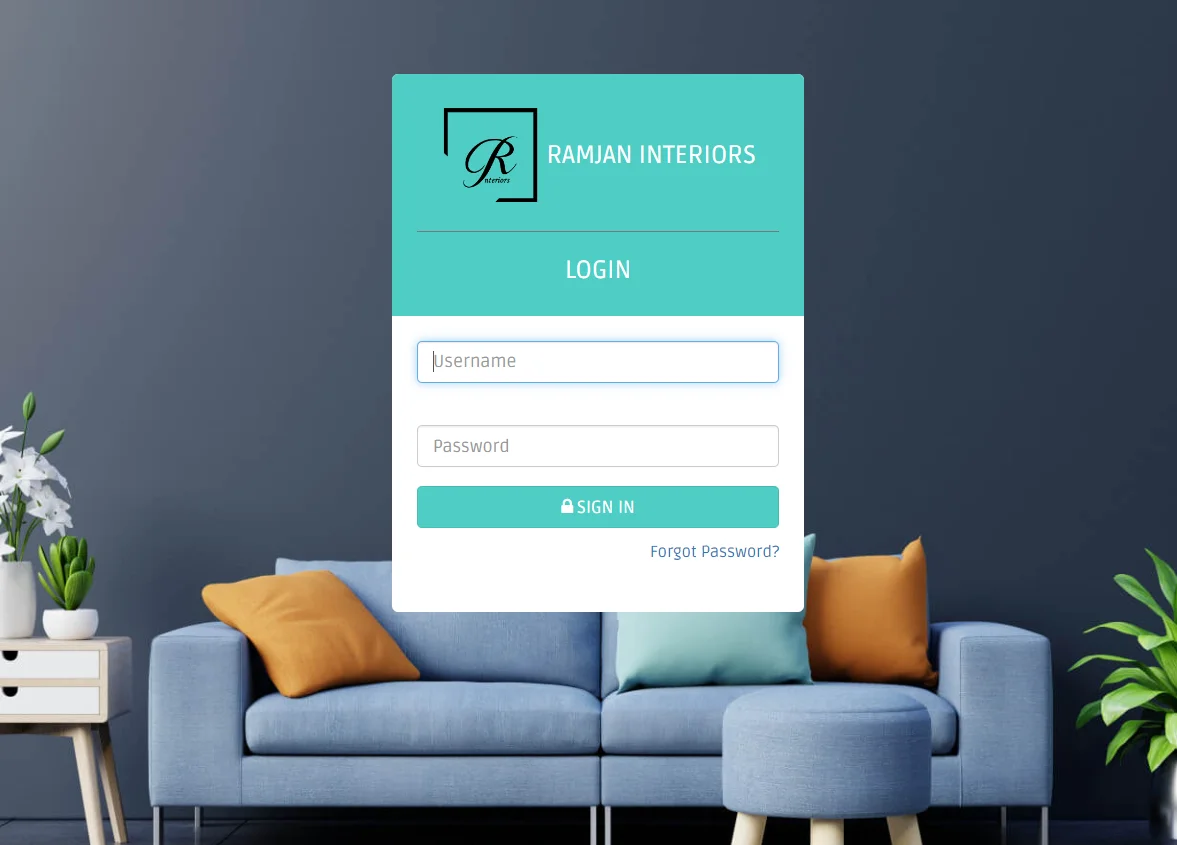
Business Management Suite for Ramjan Interiors

Gulger Mallik
Software Engineer & AI Researcher
Discover how a custom Business Management Suite revolutionized Ramjan Interiors by integrating project management, inventory, and client relations into one efficient system.
Revolutionizing Operations: The Business Management Suite for Ramjan Interiors
In the dynamic and detail-oriented world of interior design and execution, efficiency is not just an advantage—it's a necessity. Ramjan Interiors, facing the complexities of managing multiple projects, fluctuating material inventories, and detailed client specifications, recognized the critical need for operational transformation. Traditional, disparate systems were leading to data silos, delayed invoicing, and increased administrative overhead. The solution was the development of a bespoke Business Management Suite (BMS), an all-in-one platform engineered to centralize, streamline, and automate core business processes.
The Core Challenge: Fragmentation in Interior Design Management
The interior design industry demands meticulous coordination across design conceptualization, procurement, on-site execution, and financial closure. For a growing firm like Ramjan Interiors, this often meant juggling spreadsheets for inventory, separate CRM software for client communication, manual entry for time tracking, and standalone accounting tools for invoicing. This fragmentation resulted in several key pain points:
- Lack of Real-Time Visibility: Difficulty in assessing true project profitability or resource availability instantly.
- Inventory Discrepancies: Frequent stockouts or overstocking due to delayed updates between procurement and project teams.
- Client Handoff Friction: Inconsistent record-keeping leading to delays in delivering accurate quotes or final invoices.
- Inefficient Workflow: Excessive manual data entry, increasing the risk of human error.
Architecting the Solution: The Integrated BMS Framework
The development team focused on creating a modular yet deeply integrated system tailored specifically for the nuances of interior design workflows. The goal was simplicity and power—a platform that felt intuitive to the site supervisor, yet robust enough to provide executive-level analytics. This required careful attention to the four primary pillars of the Ramjan Interiors operation.
Pillar 1: Advanced Project Management
The project module became the central nervous system. It allowed managers to define project phases, assign specific tasks to team members (designers, contractors, vendors), and track progress against timelines. Crucially, every task was tied directly to resource allocation and budget tracking.
- Gantt Chart Visualization: Drag-and-drop scheduling for easy timeline adjustments.
- Dependency Mapping: Ensuring that procurement only proceeds after design sign-off.
- Mobile Access: Site supervisors can update completion status directly from the location using mobile devices.
Pillar 2: Real-Time Inventory Tracking
Managing stock—from raw materials like wood and marble to specialized fixtures—is complex. The BMS introduced a centralized inventory module featuring barcode scanning capabilities and low-stock alerts. When a designer specified a material for Project X, the system automatically checked availability and, if necessary, generated a purchase request linked directly to the vendor management pipeline.
function checkStockLevel(itemId: string, requiredQuantity: number): { available: number; needsReorder: boolean } {
  const currentStock = InventoryDB.getItem(itemId).quantity;
  if (currentStock < requiredQuantity) {
    // Trigger automated purchase order generation
    SystemAlerts.generatePO(itemId, requiredQuantity * 1.2);
    return { available: currentStock, needsReorder: true };
  }
  return { available: currentStock, needsReorder: false };
}
Pillar 3: Seamless Client Relationship Management (CRM)
The CRM component ensures every client interaction, design revision, meeting note, and approval signature is logged against their specific project file. This historical record is invaluable for dispute resolution, future upselling, and maintaining high client satisfaction scores.
Centralization means that whether a client calls the sales team or the project manager, both parties access the exact same, up-to-the-minute project status and documentation.
Pillar 4: Automated Invoicing and Financial Integration
Perhaps the most immediate ROI came from the invoicing module. By linking project milestones, material consumption (from Inventory), and approved labor hours directly to billing templates, the system drastically reduced the time taken to generate and dispatch invoices. This shortened the accounts receivable cycle significantly.
The Impact: Data-Driven Decision Making
The implementation of the Business Management Suite was not merely an IT upgrade; it was a strategic business transformation. By unifying these critical functions, Ramjan Interiors gained unprecedented control and insight into their operations.
Operational Efficiency Gains
Automation reduced the administrative burden by an estimated 30%, freeing up project managers to focus on quality control and client relations rather than paperwork. Inventory accuracy improved to near 99%, minimizing costly rush orders and material wastage.
Enhanced Financial Performance
Real-time cost tracking allowed the finance team to flag budget overruns while they were happening, not weeks later. This proactive approach to budget management directly translated into higher project margins. Furthermore, quicker invoicing meant improved cash flow.

Scalability and Future-Proofing
Because the system was custom-built to handle specific industry workflows and designed with modern architecture, it is inherently scalable. As Ramjan Interiors expands its portfolio or opens new regional offices, the BMS can absorb increased transaction volume without requiring a complete overhaul. The platform supports growth rather than constraining it.
Conclusion: The Power of Custom Integration
The Business Management Suite for Ramjan Interiors stands as a testament to the value of bespoke software solutions tailored to unique industry demands. By moving away from generic tools and investing in an integrated platform that speaks the language of interior design—managing material flow, design iterations, and client expectations simultaneously—Ramjan Interiors has achieved a new benchmark for operational excellence. This centralized approach ensures that every project, from the first sketch to the final handover, is managed with precision, transparency, and control.
Related Articles

Reverse Engineering the AI Recruiter
Learn how to optimize your resume and application process by understanding the logic behind AI...
The End of Passive AI: Inside Perplexity Computer
Discover how Perplexity's new 'Computer' interface is redefining AI interaction by shifting from...
AI Implementation Strategy
Learn how to build a scalable AI implementation strategy that delivers measurable business value...
Claude Code’s Source Leak: What Happened, Why It Matters, and What It Reveals About AI Engineering
Anthropic accidentally exposed the full source code of its Claude Code CLI, revealing internal...
Full-Stack Efficiency
Discover how to streamline your development workflow and maximize productivity by mastering the art...
Ready to Build Something Amazing?
Let's collaborate on your next project and create solutions that make a difference.
Get In Touch