
Crowther Audit Program

Gulger Mallik
Software Engineer & AI Researcher
Explore the Crowther Audit Program, a collaboration automating complex Excel audits using the ChatGPT API to boost efficiency and accuracy by 40%.
Revolutionizing Auditing: The Crowther Audit Program
The accounting and auditing professions have long relied on meticulous, yet time-consuming, manual processes. Traditional audits often involve sifting through vast amounts of data locked within complex, often bespoke, Excel spreadsheets—a process prone to human error and significant time expenditure. Recognizing this bottleneck, the University of Huddersfield partnered with Crowther Accountants to pioneer a transformative solution: The Crowther Audit Program.
This ambitious initiative sought to bridge the gap between established financial compliance standards and cutting-edge intelligent automation. By integrating advanced large language models, specifically the ChatGPT API, the project aimed to create a system capable of interpreting, validating, and extracting critical data points from unstructured spreadsheet environments automatically. The goal was clear: to significantly streamline the data handling phase of auditing, thereby freeing up human auditors to focus on high-level analysis and strategic decision-making.
The Core Challenges in Automating Financial Data Extraction
While the promise of automation is compelling, the implementation within a regulated field like auditing presents unique and formidable obstacles. The Crowther Audit Program faced several critical challenges that required innovative technical and procedural solutions.
Interpreting Unstructured Spreadsheet Logic
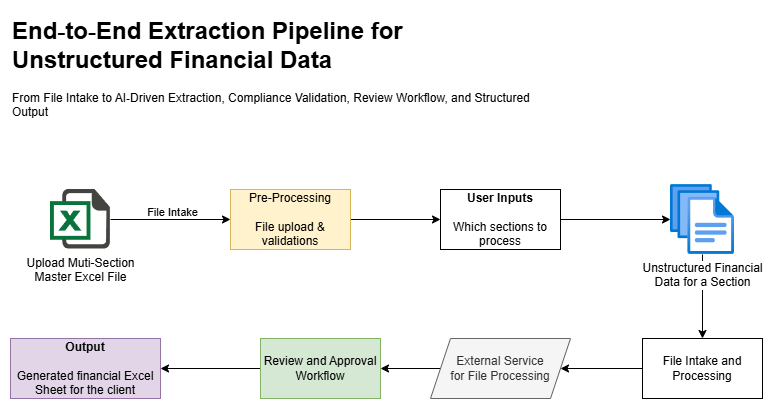
The single most significant hurdle was teaching an AI model to 'read' and understand the context of data within diverse Excel files. Unlike structured databases, spreadsheets often contain embedded business logic, custom formulas, merged cells, and non-standard labeling. The automation needed to correctly identify key financial figures, reconcile differences between linked sheets, and flag anomalies that deviated from expected patterns—all without explicit, pre-programmed rules for every potential spreadsheet configuration. Relying on the ChatGPT API meant moving beyond simple pattern matching to true contextual interpretation.
- Contextual Ambiguity: Distinguishing between a placeholder value and a critical data point based on surrounding text or formatting.
- Anomaly Detection: Developing prompts robust enough to catch subtle discrepancies that might indicate fraud or error, rather than just format mismatches.
Data Security and Regulatory Compliance
Handling client financial data mandates stringent adherence to data protection laws and professional auditing standards. Integrating a third-party API (ChatGPT) introduced concerns regarding data transit, storage, and privacy guarantees. Ensuring that sensitive information was processed securely, anonymized where necessary, and remained compliant throughout the automated workflow was non-negotiable. This required careful selection of API usage tiers and robust encryption protocols.
User Adoption and Interface Design
Auditors are experts in finance, not necessarily in bespoke software interfaces. A complex or unintuitive system would lead to rejection, regardless of its technical brilliance. Therefore, designing a user experience (UX) that mirrored familiar workflows while clearly presenting the AI's findings and allowing for easy overrides was a major design priority.
Solutions and Implementation Architecture
The technical implementation of the Crowther Audit Program was built around a resilient, modular architecture designed for scalability and maintainability. The team opted for proven, industry-standard technologies to manage the backend logic and data persistence.
Technology Stack Foundation
- Backend Processing: Python was selected for its extensive libraries suitable for data manipulation and API interaction. The Django framework provided a robust structure for handling application logic and secure request management.
- Data Persistence: MySQL was chosen as the relational database for storing processed metadata, audit logs, and configuration settings, ensuring structured and queryable data integrity.
Intelligent Data Parsing via LLM Integration
The core innovation lay in the strategic use of the ChatGPT API. Instead of building complex, brittle traditional parsers or training bespoke machine learning models, the system framed the data extraction task as a sophisticated natural language processing (NLP) problem. The Excel file contents (or structured representations of them) were fed into the API with highly specific prompts. These prompts instructed the model to act as an expert auditor, identifying required variables, cross-referencing data points, and outputting the results in a standardized JSON format.
By leveraging the LLM's inherent reasoning capabilities, the system could interpret semantic meaning within the spreadsheets, bypassing the need to explicitly map every potential cell location or formula variation.
This approach significantly reduced development overhead compared to traditional automation, as the LLM generalized well across varied inputs, provided the prompting strategy was sound.
Collaborative UX Design
To ensure successful adoption, the development team worked iteratively with Crowther Accountants. The resulting user interface was designed to act as an intelligent assistant rather than a black box. Auditors could upload files, view the AI's confidence scores for extracted data, easily review flagged discrepancies side-by-side with the original source data, and manually approve or modify the automated results before finalization.
Tangible Achievements and Industry Impact
The deployment of the Crowther Audit Program marked a significant milestone in the application of generative AI within professional services. The measurable successes validate the strategy of using LLMs for contextual data interpretation in highly regulated environments.
Dramatic Efficiency Gains
The most immediate and impactful result was the radical reduction in processing time. The program successfully automated substantial portions of the data ingestion and preliminary validation phases. Empirical testing demonstrated that the Crowther Audit Program reduced the overall time required for audit preparation and initial review by up to 40%.
- Faster Turnaround: Enabling firms to handle higher audit volumes without proportionally increasing staffing.
- Resource Reallocation: Shifting auditor focus from tedious data reconciliation to complex judgment areas, such as risk assessment and strategic client advisory.
Enhanced Accuracy and Consistency
Automation inherently removes human fatigue and subjective interpretation from repetitive tasks. The system consistently applied the same rigorous logic to every file, leading to a higher baseline quality in data handling. Furthermore, the system’s ability to flag subtle inconsistencies that might be overlooked during a manual review improved the detection rate of potential financial errors.
A Blueprint for Future Automation
The Crowther Audit Program serves as a powerful proof-of-concept. It demonstrates that sophisticated, context-aware AI tools can be successfully integrated into highly sensitive business processes without requiring the overhead of custom machine learning model training. This success paves the way for broader adoption of LLM-powered tools across other data-intensive domains within finance and compliance, setting a new standard for efficiency and precision in auditing.
Related Articles

The Post-IDE Era: Coding with Autonomous Agents
Explore the transition from traditional IDEs to autonomous coding agents and how AI is redefining...
The End of Passive AI: Inside Perplexity Computer
Discover how Perplexity's new 'Computer' interface is redefining AI interaction by shifting from...
AI Implementation Strategy
Learn how to build a scalable AI implementation strategy that delivers measurable business value...

Unlocking Gemma 4 and Beyond
Discover Google’s AI Edge Gallery, an on-device sandbox that brings powerful generative AI,...
Claude Code’s Source Leak: What Happened, Why It Matters, and What It Reveals About AI Engineering
Anthropic accidentally exposed the full source code of its Claude Code CLI, revealing internal...
Ready to Build Something Amazing?
Let's collaborate on your next project and create solutions that make a difference.
Get In Touch